
Robert Leroy Johnson, born on May 8, 1911, in Hazlehurst, Mississippi, is one of the most influential and enigmatic figures in the history of American music. Often referred to as the “King of the Delta Blues,” Johnson’s raw, haunting guitar work and soulful vocals laid the foundation for modern blues, rock, and countless other genres. Despite his brief life and limited recorded output, his music and the myths surrounding him have cemented his status as a legend.

Johnson was born into the harsh realities of the Jim Crow South, where racial segregation and economic hardship defined life for African-Americans. His mother, Julia Major Dodds, was married to Charles Dodds, a prosperous landowner and carpenter, but Robert was the product of an affair with Noah Johnson, a plantation worker. Growing up in a large family – Julia had ten children with Dodds – his early years were marked by instability. His mother moved frequently, and young Robert lived between Hazlehurst, Memphis, and Robinsonville, MS, often facing poverty and discrimination. As a child, he showed an early interest in music. He initially played harmonica and jaw harp, but the guitar would become his defining instrument. By his teens he came under the influence of local blues musicians like Willie Brown, Charley Patton, and Son House, giants of the Delta blues scene. Johnson’s stepfather, Charles Dodds (who relocated to Memphis after a dispute with white landowners), was a strict figure, and Robert’s desire to pursue music often clashed with expectations to work the fields.
Johnson married Virginia Travis in 1929, and the couple had a child who died in infancy. Tragically, Virginia died in childbirth in 1930, a loss that deeply affected the young musician and likely contributed to the emotional depth of his later work. Around this time, Johnson began to focus intensely on the guitar, though early accounts from peers like Son House suggest he was initially a mediocre player.
One of the most enduring musical legends is about Johnson and his deal with the Devil at a Mississippi crossroads of Highways 61 and 49 (although exact crossroads are disputed), where he supposedly traded his soul for unparalleled musical talent. This myth, rooted in folklore and likely amplified by Johnson’s own cryptic references in songs like “Cross Road Blues,” emerged after his remarkable transformation as a musician. Around 1930 – 31, Johnson briefly left Robinsonville, possibly to hone his skills in Hazlehurst or elsewhere. When he returned, his guitar playing and singing had improved dramatically, astonishing his peers. Suddenly, he could pluck out entire band arrangements with just a six-string guitar. He could punctuate a bass line while he plucked a melody on the high strings, all while maintaining a percussive rhythm. While the crossroads story is apocryphal, it reflects the mystique surrounding Johnson’s rapid mastery of the guitar. He likely studied with mentors like Ike Zimmerman, a skilled guitarist from Hazlehurst, and absorbed influences from records by artists like Lonnie Johnson and Blind Lemon Jefferson. Others say he went into Arkansas. Johnson’s ability to blend intricate fingerpicking, slide guitar, and expressive vocals set him apart, creating a sound that was innovative and rooted in Delta blues traditions.
By the early 1930s, Johnson was a traveling musician, performing in juke joints, plantations, and street corners across the Mississippi Delta and beyond. His repertoire included not only blues but also popular songs, spirituals, and even polkas, showcasing his versatility. He was known for his charisma and ability to adapt his performances to different audiences, though his itinerant lifestyle and reputation as a womanizer often stirred trouble.
In 1936, Johnson got his break when talent scout H.C. Speir recommended him to the American Record Corporation (ARC). In November 1936, Johnson traveled to San Antonio, Texas, for his first recording session in a makeshift studio at the Gunter Hotel. Over three days, he recorded 16 songs, including classics like “Cross Road Blues,” “Sweet Home Chicago,” “I Believe I’ll Dust My Broom,” and “Terraplane Blues.” The latter became a regional hit, selling around 5,000 copies – a significant achievement for a blues record at the time. Johnson’s second and final recording session took place in Dallas in June 1937, where he recorded 13 more tracks, including “Hellhound on My Trail,” “Me and the Devil Blues,” and “Love in Vain.” These 29 recordings (including alternate takes) constitute the entirety of his known output. His songs are marked by intricate guitar work, with techniques like bottleneck slide and rhythmic “boogie” basslines, paired with lyrics that explore themes of love, betrayal, restlessness, and existential dread. His voice, often described as haunting, conveyed a raw emotional intensity that resonated with listeners.


Johnson’s personal life was as itinerant as his music career. He never settled in one place for long, traveling across the South and as far as Chicago, St. Louis, and even Canada. He had relationships with multiple women, including an informal marriage to Caletta Craft in the early 1930s, though no legal records exist. His charm and good looks made him a favorite among women, but also led to conflicts, as he often pursued romance with married women or partners of other men. Despite his reputation as a loner, Johnson was sociable and adaptable, able to perform for both black and white audiences in an era of strict segregation. He was also known for his secrecy, sometimes turning his back on other musicians while playing to prevent them from learning his techniques.
Robert Johnson’s life ended tragically and mysteriously on August 16, 1938, at the age of 27. While performing near Greenwood, Mississippi, he fell ill and died. The official cause of death was not recorded, but the most widely accepted account is that he was poisoned, possibly by a jealous husband or lover who spiked his whiskey with a toxin. Other theories include death from syphilis, pneumonia, or congenital health issues, but no definitive evidence exists.
Johnson’s death at 27 later fueled the “27 Club” myth, a cultural phenomenon linking the premature deaths of musicians like Jimi Hendrix, Janis Joplin, and Kurt Cobain, all of whom died at the same age. The lack of a death certificate, autopsy, or even a marked grave added to the mystique surrounding Johnson’s life and demise. His death was barely noted at the time, and it was only decades later that his music and story gained widespread recognition.
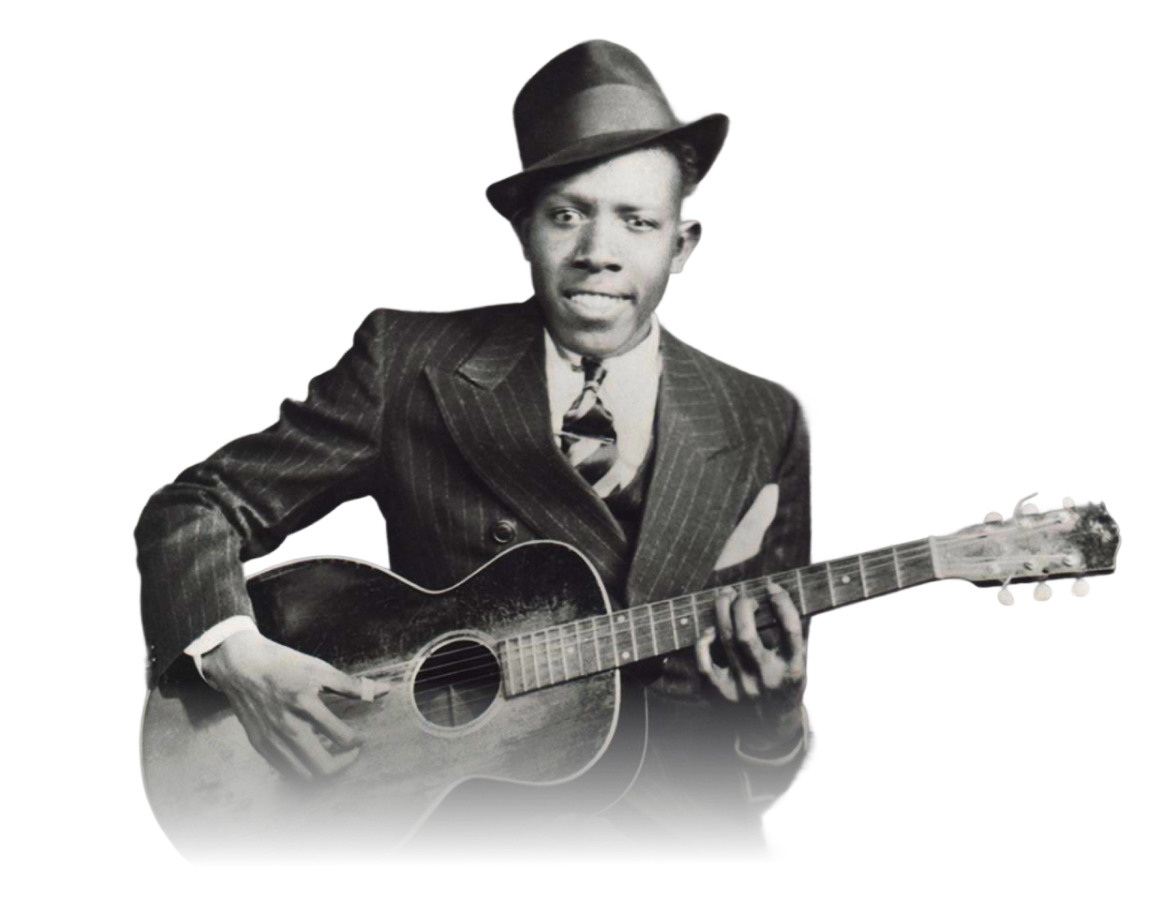

At the time of his death, Robert Johnson was a relatively obscure figure, known primarily in the Delta blues circuit. His recordings sold modestly, and the Great Depression limited the commercial reach of race records. However, his music found a second life in the 1960s, when Columbia Records released the compilation King of the Delta Blues Singers in 1961. This album introduced Johnson to a new generation, particularly white audiences and musicians in the burgeoning rock and folk scenes. Artists like Eric Clapton, The Rolling Stones, Led Zeppelin, and Bob Dylan cited Johnson as a major influence. Clapton called him “the most important blues musician who ever lived.” His influence extends beyond rock to genres like folk, country, and even hip-hop, where his storytelling and emotional depth resonate.
Johnson’s technical innovations – particularly his use of complex chord progressions, slide guitar, and rhythmic patterns – helped shape the sound of modern blues and rock. Songs like “Sweet Home Chicago” became standards, adopted as anthems by cities and musicians. His lyrics, blending vivid imagery with universal themes of longing, remain timeless.
In 1990, Columbia released The Complete Recordings, a box set that won a Grammy and introduced Johnson to an even wider audience. His image has since appeared in films, books, and documentaries, including the 1986 film Crossroads and the 1991 documentary The Search for Robert Johnson. In 2003, he was ranked fifth on Rolling Stone’s list of the greatest guitarists of all time, and his songs continue to be covered and reinterpreted.
Robert Johnson’s life and music are inseparable from the cultural context of the early 20th-century South. As an African American artist in the Delta, he faced systemic racism, economic exploitation, and limited opportunities, yet he created music that transcended these constraints. His songs capture the struggles and resilience of black life in the Jim Crow era, while their universal themes of love, loss, and existential searching resonate across cultures and generations. His small discography – 29 songs recorded in two sessions – belies his outsized impact.
He synthesized the Delta blues tradition with his own innovations, creating a sound that was both deeply traditional and strikingly modern. His influence on rock and roll, a genre that would dominate global music, underscores his role as a bridge between African American musical traditions and mainstream popular culture, earning the designation “King of the Delta Blues.”

Be the first to add your voice.